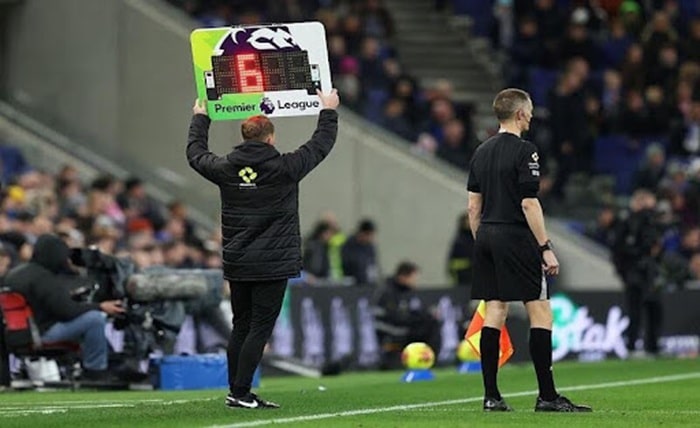
Stoppage time in football is the additional period added by the referee at the end of each half to compensate for minutes of play that were interrupted. It is a familiar part of every match, but the way the number of stoppage-time minutes is determined is not always the same.
Understanding this rule helps fans follow matches more accurately, especially when a team is attacking or protecting a lead in the final minutes. When watching football on 90p TV, many viewers often pay attention to the electronic board displaying the number of stoppage-time minutes because just a few additional minutes can completely change the outcome of a match.
What Is Stoppage Time?
Stoppage time in football is the additional period added by the referee at the end of each half to compensate for time lost due to situations that prevent the match from continuing uninterrupted.
According to Law 7 of IFAB, stoppage time is calculated for significant periods of time lost during each half. The referee is responsible for determining the number of additional minutes, which are communicated through the fourth official.
Common causes of stoppage time include substitutions, injuries, time-wasting, VAR checks, prolonged goal celebrations, or unexpected incidents that cause the match to be temporarily stopped.
Why Does Football Need Stoppage Time?
Unlike some sports where the clock stops immediately whenever play is interrupted, football match time generally continues to run. Therefore, if a match is stopped for several minutes because of an injury or substitution, the actual playing time will be shorter than the prescribed duration.
Stoppage time helps address this issue by adding an appropriate amount of time. The goal is to ensure that both teams have enough playing time according to the rules while limiting attempts by a team to deliberately waste time to protect a lead.
Fans watching 90Phut TV may notice that the referee usually announces stoppage time just before the official playing time of the half ends. The number displayed on the electronic board is only the minimum amount announced, and the referee can extend the match further if additional time-consuming incidents occur.
Situations That Count Toward Stoppage Time
There are many reasons why a referee may need to add extra time. Substitutions are among the most common situations because the process of a player leaving the pitch and the replacement entering can interrupt the match.
Injuries also frequently cause playing time to be extended. If a player needs medical attention on the pitch or has to leave the field on a stretcher, the referee will add the lost time at the end of the half.
In addition, time-wasting, prolonged goal celebrations, VAR checks, penalty situations, or incidents that cause the match to be temporarily stopped may also be included in stoppage time.
When following the football schedule, fans usually know the exact scheduled start time and expected duration of a match. However, the actual final whistle may come later because of stoppage time.
How Does the Referee Calculate Stoppage Time?
The referee monitors periods of lost time throughout the half. The fourth official assists with time management and announces the number of stoppage-time minutes that have been determined.
For example, if the second half includes several substitutions, some players require treatment for injuries, and VAR takes time to review an incident, the referee may determine that several minutes have been lost. That number will be announced before the official playing time ends.
It is important to note that the number displayed on the board does not mean the match will definitely end immediately when the clock reaches that number. If another time-consuming incident occurs during stoppage time, the referee has the authority to add more time.
This is why matches broadcast on 90 Phút TV sometimes finish later than originally expected.
How Is Stoppage Time Different From Extra Time?
Stoppage time and extra time are two completely different concepts. Stoppage time appears during regular periods of play to compensate for time that has been lost. Extra time, meanwhile, is only used in certain knockout matches that require a winner to be determined.
A regular 90-minute match may end after 94, 97, or even more minutes depending on the amount of time lost. This is still considered playing time within the two regular halves.
In contrast, if a cup match requires a winner and the two teams remain level after 90 minutes plus stoppage time, they may enter two periods of extra time. Each period of extra time usually lasts 15 minutes before a penalty shootout is used if necessary.
This information is particularly useful when fans follow 90Phut and want to distinguish between the actual end of a match and additional playing time.
How Does Stoppage Time Affect a Match?
The final minutes of a match are often extremely important. A team that is leading may have to focus on defending, while the team that is behind will try to make the most of every opportunity to score.
If the referee announces several minutes of stoppage time, the pressure on the leading team becomes even greater. Conversely, the attacking team has more time to search for a goal.
Football history has witnessed many goals being scored during stoppage time. Some goals have helped teams secure victory, while others have been late strikes that caused a team to lose an advantage that had seemed almost certain.
Why Is Stoppage Time Becoming Longer?
In modern football, the amount of stoppage time has tended to increase in many matches because there are more factors that cause interruptions. VAR is one notable reason, as referees sometimes need considerable time to review complex incidents.
In addition, the time spent celebrating goals, making substitutions, and treating injuries is taken into greater consideration. Efforts to combat time-wasting also mean that referees tend to account more fully for the time that has been lost.
When checking the lịch thi đấu bóng đá, viewers should understand that the time shown on the schedule is only the expected timeframe. A match may finish later depending on what happens during the game.
Stoppage Time Can Change the Result of a Match
One of the most exciting aspects of football is that the result is not certain until the referee blows the final whistle. A team may lead for most of the match but still lose its victory in the final minutes.
Teams often develop specific tactics for the stoppage-time period. The leading team may prioritize keeping possession and minimizing risks, while the trailing team will push its defensive line higher and bring more attacking players into the penalty area.
For viewers of 90m TV, stoppage time is often the most noteworthy period because a single set piece, counterattack, or defensive mistake can create a turning point.
What Should Fans Keep in Mind When Following Stoppage Time?
When the electronic board announces the number of stoppage-time minutes, viewers should not interpret it as the exact moment when the match will end. It is the minimum amount of additional time determined by the referee based on the interruptions that have already occurred.
If another injury, substitution, or incident requiring a review occurs during stoppage time, the referee may extend the match further. Therefore, predicting the exact moment of the final whistle is sometimes difficult.
People who regularly follow the football schedule should also distinguish between the official playing time and the actual time when the match ends. This is particularly important when following several matches in succession.
Conclusion
Stoppage time in football is an important mechanism used to compensate for periods of time lost during each half. Substitutions, injuries, VAR, time-wasting, and other interruptions can all cause the referee to add additional time. Through the online football platform 90Phut, viewers can follow all the exciting developments right up until the final whistle.